
Blog
How to Choose the Best Hot Tub Layout: Round, All-Seat or Lounger?

Most people start shopping for a hot tub by comparing size and price. But the thing that decides whether you’ll actually look forward to using it every evening is the hot tub layout. Where you sit, how you sit and who sits next to you shapes every single soak.
If you’re wondering how to choose a hot tub, this guide walks through the four main hot tub layouts, who each one suits best, and the practical checks you should make on space, power and features before you choose a model.
Start With How You’ll Actually Use It
Before you look at any spec sheet, answer three simple questions:
- How many people will use it on a normal evening? Not the maximum number of guests you might host once a year, but the number of people who will realistically be in the water most nights.
- Do you prefer to sit upright and talk, or stretch out and recline? Some people want a social space; others want a quiet, full-body soak.
- Is it mainly for relaxation and time together, or for targeted hydrotherapy? Your answer changes which seats and jet arrangements matter most.
Your answers to these three questions will point you toward the right hot tub layout faster than any spec sheet.
A good rule of thumb: choose a hot tub sized for your regular use, with one or two extra seats for guests. A spa that is far bigger than you need means more water to heat, more water to treat and a larger cover to lift.
The Four Main Hot Tub Layouts
1. Round Hot Tubs
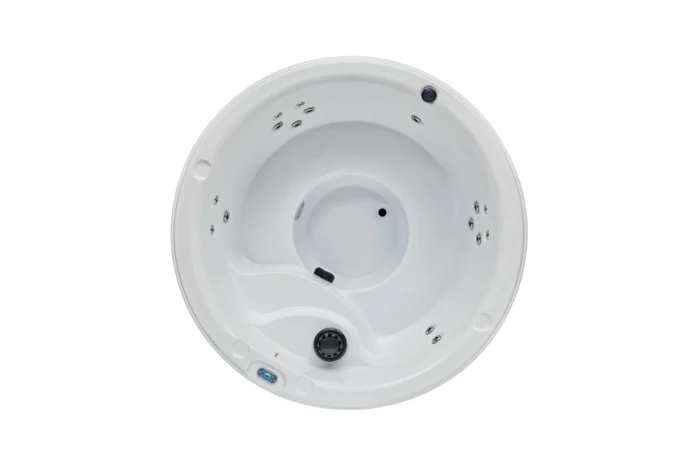
A round hot tub layout places every seat around a circle, so everyone faces the centre. There are no corners and no lounger taking up space, which makes conversation feel natural and keeps the footprint compact.
Because the seats are arranged evenly, no one gets “the bad seat”. The trade-off is that a round spa usually seats fewer people than a square model of similar size, and it doesn’t offer a full-length reclining position.
Best for: couples, small families and smaller patios or decks.
Onyx example: the Onyx X5R is a 5-person round spa measuring 78″ (200 cm) across, with 16 stainless steel therapy jets, a 1.5 HP twin-speed jet pump and a choice of 110V or 240V configuration.
2. All-Seat Hot Tubs

An all-seat hot tub layout fills the perimeter with upright seats instead of a lounger. This gives you the most seats for the space, and the seats usually vary in depth and jet pattern, so each person can find a position that feels right.
Everyone sits upright and faces each other, so an all-seat hot tub layout is the most sociable option. If you regularly have the whole family or friends over, this is usually the layout to look at first.
Best for: families, entertaining and anyone who values seating capacity over reclining.
Onyx examples: the Onyx X6A is a 6-person all-seat spa, and the Onyx X8E is an 8-person all-seat spa with an infinity edge, underwater LED lighting and top-skimming filtration.

3. Single Lounger Hot Tubs
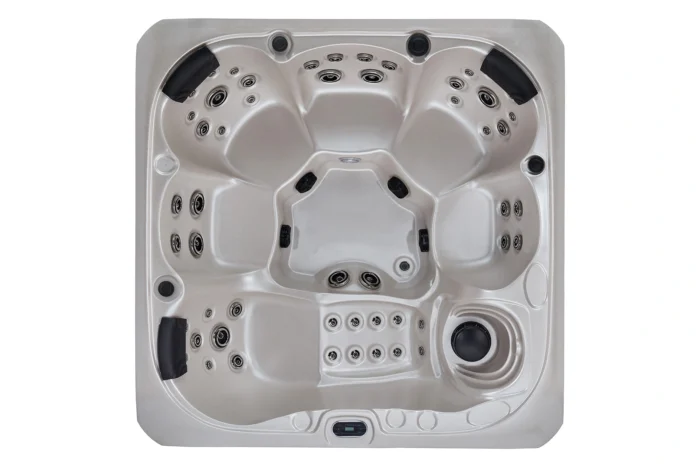
A single lounger hot tub layout combines several upright seats with one full-length reclining seat. In the lounger, jets typically run from the shoulders down to the legs and feet, giving a more complete body massage than an upright seat.
The lounger takes up roughly the space of two upright seats, so total capacity is a little lower. It’s also worth knowing that shorter or lighter users can sometimes feel buoyant in a lounger and float out of position. If possible, sit in one before you buy.
Best for: people who mainly soak alone or as a couple and want a full-body hydrotherapy seat, while still keeping upright seats for guests.
Onyx example: the Onyx X6L is a 6-person single lounger spa with a cushioned headrest, built-in LED lighting and a high-power jet system.
4. Double Lounger Hot Tubs

A double lounger hot tub layout places two reclining seats side by side, with upright seats around the rest of the spa. It’s designed for couples who both want to stretch out at the same time, instead of taking turns in a single lounger.
The trade-off is fewer upright seats, so a double lounger is less suited to large groups.
Best for: couples who use the spa together most evenings and both want to recline.
Onyx example: the Onyx X6D is a 6-person double lounger spa.
Hot Tub Layouts at a Glance
| Layout | Best for | Strengths | Trade-offs | Onyx models |
|---|---|---|---|---|
| Round | Couples, small families, compact spaces | Face-to-face seating, no “bad seat”, smaller footprint | Fewer seats, no reclining position | X5R |
| All-seat | Families and entertaining | Most seats for the space, very sociable | No full-length reclining seat | X6A, X8E |
| Single lounger | Solo soakers and couples who want full-body massage | Full-length jet coverage, room to stretch out | Lounger uses the space of about two seats | X6L |
| Double lounger | Couples who both want to recline | Two people can stretch out at once | Fewer upright seats for guests | X6D |
Check Your Space Before You Choose a Model

Once you have a hot tub layout in mind, make sure the spa will fit where you want it, not just on paper but in practice.
- Measure the footprint plus clearance. Leave enough room around the spa for servicing the equipment, opening the cover and placing steps.
- Prepare a level, stable base. The base must support the full weight of the spa once it’s filled with water and people. A concrete pad or a properly engineered deck is the usual choice. Ask for the filled weight of the model you’re considering.
- Check the delivery path. Gates, tight corners, steps and narrow side passages can all block delivery. Measure the narrowest point between the street and the installation spot before you order.
- Plan for power and drainage. The spa needs a suitable electrical connection nearby and a sensible way to drain the water when you change it.
Our FAQ covers delivery preparation in more detail.
110V or 240V? Understand the Power Options

In North America, many hot tubs are offered in either a 110V or a 240V configuration. The right choice depends on your climate and how often you plan to use the spa.
- 110V setups are simpler to install, but they have less heating power. Water takes longer to heat, and on many 110V spas the heater pauses while the jets run on high speed. This can work well in milder climates or for lighter use.
- 240V setups require a dedicated circuit installed by an electrician. They heat faster and allow the heater and jets to run at the same time, which makes a real difference in cold weather and with frequent use.
Outside North America, household supply is typically 220–240V, so the main question is whether you need a dedicated circuit. Whichever region you’re in, all electrical work should be completed by a qualified electrician in line with local codes. For general guidance on GFCI protection and safe wiring around water, see the Electrical Safety Foundation International’s pool and spa safety tips. The Onyx X5R is available in either 110V or 240V configuration.
Features That Matter, Whatever Hot Tub Layout You Choose

- Jet placement and variety. Look at where the jets sit, not just how many there are. Jets aimed at the back, shoulders and feet matter more than a big headline number. An air control that lets you adjust the jet intensity is a useful bonus.
- Headrests and seat contours. Supportive headrests and well-shaped seats are what make a long soak comfortable.
- Filtration and water care. A top-skimming filtration system removes floating debris from the surface, and ozone water care helps keep the water clear with less effort.
- Insulation and cover. Good insulation and a tapered all-weather cover that sheds rain and snow help keep heat in, especially in winter.
- Lighting and controls. Underwater LED lighting makes evening soaks more enjoyable, and an easy-to-read control panel keeps temperature and jet settings within reach.
- Warranty. Check exactly what the warranty covers and how support works in your region. You can read the Onyx Warranty Policy for details.

Quick Checklist Before You Buy
- How many people will use the spa on a typical evening?
- Which hot tub layout suits you: upright, social seating or a reclining lounger?
- Have you measured the space, including clearance for service and the cover?
- Is your base level and strong enough for the filled weight?
- Can the spa get from the street to the installation spot?
- Do you know which electrical setup you need, and do you have an electrician lined up?
- Have you compared jet placement, filtration, insulation and warranty, not just price?
Frequently Asked Questions
Is a bigger hot tub always better?
No. A bigger spa means more water to heat and treat, a heavier filled weight and a larger cover. Choose a size that matches how many people will use it regularly, with a seat or two to spare.
Should I choose a lounger or an all-seat hot tub layout?
If you mostly soak alone or as a couple and want a full-body massage, a lounger is worth considering. If you often share the spa with family or friends, an all-seat hot tub layout gives everyone a proper seat.
Can I use a hot tub in winter?
Yes. For many owners, winter is the best time to soak. Keep the spa powered and running normally in freezing weather, and follow proper winterization steps if it will be shut down for a long period.
Find the Right Onyx Spa for Your Home
Onyx offers round, all-seat, single lounger and double lounger hot tub layouts for 5 to 8 people. You can browse the full collection to compare models side by side.
Not sure which hot tub layout suits your space? Get a quote and tell us about your space and how you plan to use your spa, and we’ll help you choose the right model.